Why Hotel Pricing Is Getting Harder to Get Right
A hotel room does not have one correct price. The right rate for a Tuesday in a slow month is not the right rate for a festival weekend, and the right rate for a guest booking two months out is not the right rate for a guest walking in tonight. Demand now shifts by the day, sometimes by the hour, shaped by competitor moves, local events, OTA promotions and booking pace that a spreadsheet updated once a week simply cannot keep up with.
Manually setting room rates worked when demand moved slowly and a revenue manager could review rates once a week and stay ahead of it. That is rarely true anymore. Checking competitor rates by hand, guessing at how a local event will move demand, and updating rates across every channel one at a time is slow, inconsistent, and easy to get wrong under time pressure, especially for independent and multi-property teams without a dedicated revenue department.
This is the gap AI pricing for hotels is built to close. In simple terms, it is software that continuously reads demand signals, market movement and a property's own booking history, then recommends a room rate that reflects what is actually happening right now, not what a rate calendar assumed a month ago.
What Is AI Pricing for Hotels?
AI pricing for hotels, sometimes called AI-driven pricing or hotel dynamic pricing, is the use of software to continuously analyze demand and market conditions and recommend a room rate for each date and room type, instead of relying on a fixed rate calendar that a person updates by hand.
Dynamic pricing itself is not new to hospitality; hotels have adjusted rates by season and occupancy for decades. What AI pricing changes is how many signals can be considered at once, and how quickly. Rather than one person weighing two or three factors from memory, an AI revenue management system analyzes dozens of data points, demand, competitor rates, booking pace, cancellations, events and more, and turns them into a rate recommendation that a revenue manager can review, adjust, or approve.
It is a natural extension of what modern hotel management software already does for reservations and operations: connecting scattered information into one system that actually works with the pace of the business.
How AI Pricing Works
AI pricing does not guess. It works from a defined set of signals, most of which a revenue manager already tracks in some form, just not all at once, continuously, and across every room type and date.
Signals AI pricing analyzes
Projects how many rooms are likely to sell for a given date, based on how similar dates have booked in the past and how this one is trending so far.
Recognizes recurring patterns across the year, such as festive weeks, wedding season, or the slower stretch after a peak, and prices ahead of them rather than reacting late.
Watches how quickly rooms for a date are filling up compared to a normal pace, which is often a stronger signal than occupancy on its own.
Tracks what comparable properties nearby are charging for the same dates, so a rate is set relative to the live market rather than a fixed rack rate.
Factors in weddings, conferences, festivals and concerts nearby that can pull demand up sharply for a handful of specific dates.
Learns from months or years of past reservations, cancellations and rate changes to understand how this specific property actually behaves.
Considers how many rooms of a given type are left to sell, since a nearly sold-out room type behaves very differently from one with plenty of open inventory.
Accounts for how often bookings for a date type historically fall through, so pricing and availability stay realistic rather than overly optimistic.
Distinguishes a guest booking months ahead from one booking tonight, since these two guests respond to price very differently.
Reads how demand is shifting across channels, so a rate makes sense whether the booking lands through an OTA or the hotel’s own website.
A rate that made sense this morning can be out of step with the market by evening, especially close to the stay date.
Nearby properties adjust rates too, so a fixed rate quietly drifts out of line with the market it competes in.
A handful of well-timed rate adjustments across a season add up to meaningfully more revenue than a handful of big, late ones.
From Data to Pricing Decisions
Collecting signals is only half the job; the other half is turning them into a rate a hotel can actually use. An AI hotel pricing engine weighs each signal against how much it has historically moved demand for that property, room type and date, then produces a recommended rate along with the reasoning behind it, for example, strong booking pace plus a nearby event plus competitors trending up.
That recommendation typically flows straight into the property's rate plans and, through a channel manager, out to every OTA and the hotel's direct booking site at once, instead of a rate being updated on one channel and forgotten on the rest. As new bookings, cancellations or competitor moves come in, the recommendation updates again, so pricing keeps pace with a market that does not wait for the next scheduled review.
Example: How AI Can Change a Hotel's Price
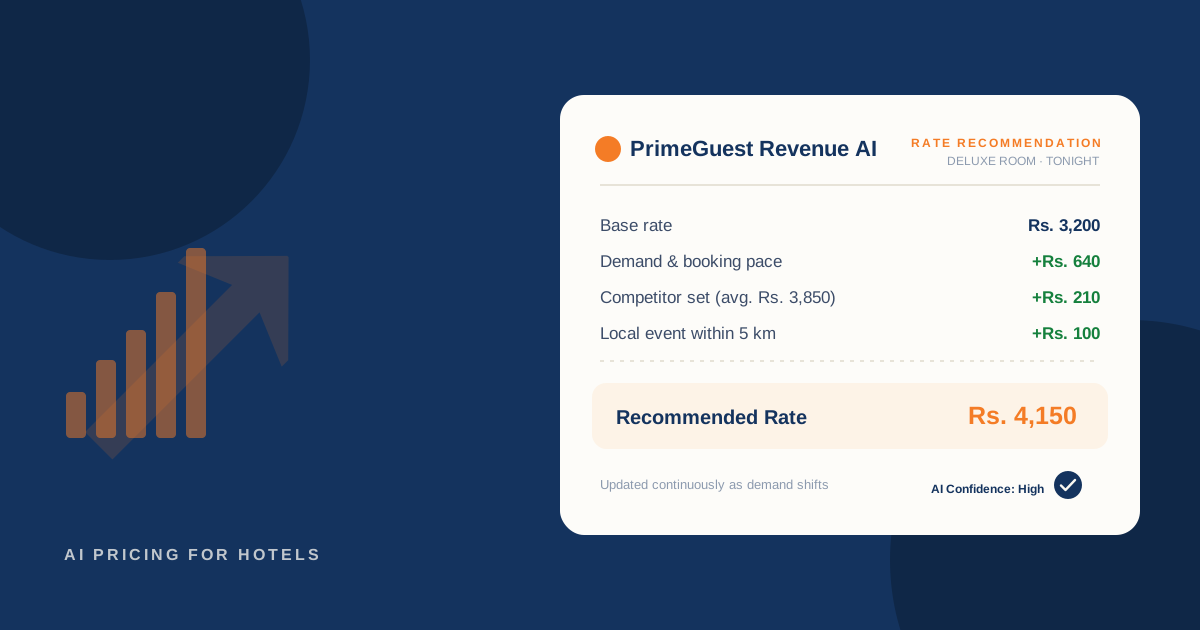
A simple example makes this concrete. Say a deluxe room is rate-loaded at Rs. 3,200 for a Saturday night, based on the property's standard weekend rate.
Booking pace for that Saturday is running well ahead of a normal week, a concert is scheduled 3 km away, and nearby competitors have already moved their weekend rate up.
AI raises the recommended rate so the property captures the extra demand instead of selling out cheap.
Bookings for the same room type three weeks out are trailing behind the usual pace, and competitor rates in the set have started to drift down.
AI lowers the recommended rate early enough to protect occupancy, rather than discounting late once rooms are already unsold.
The numbers change; the principle does not. AI pricing moves the rate toward what the market will support, in either direction, and does it early enough for the adjustment to actually matter.
AI Pricing vs. Manual Pricing
| Area | AI pricing | Manual pricing |
|---|---|---|
| Data analysis | Processes dozens of signals continuously: demand, seasonality, competitors, events and history. | Limited to what a revenue manager can realistically track by hand, usually a handful of metrics. |
| Speed | Rates can be re-evaluated in near real time as demand shifts through the day. | Rate reviews typically happen daily, weekly, or on a fixed schedule. |
| Demand forecasting | Learns from historical booking patterns and current pace to project demand ahead of time. | Relies on experience and gut feel, which is hard to quantify or repeat consistently. |
| Competitor monitoring | Tracks competitor rates continuously, across dates and room types. | Spot-checked periodically, so rate changes between checks are easy to miss. |
| Pricing consistency | Applies the same logic across every room type, date and channel. | Varies by who is setting the rate and how much time they have that day. |
| Revenue opportunities | Surfaces small, frequent adjustments that compound into meaningful revenue over a season. | Tends to catch only the obvious swings, like a major local event. |
| Human effort | A revenue manager reviews and approves recommendations rather than building every rate from scratch. | Every rate change is manually researched, calculated and entered. |
Benefits of AI Pricing for Hotels
Rates are grounded in current demand and market data rather than a rate sheet updated once a month.
Recommendations update as conditions change, instead of waiting for the next scheduled rate review.
Pricing and availability move together, so a property is less likely to sell out too early or sit under-occupied at the wrong rate.
Revenue managers spend less time recalculating rates by hand and more time reviewing and refining strategy.
A new event, a competitor drop, or a sudden dip in bookings gets reflected in pricing quickly, not after the fact.
Patterns across seasons and room types become visible, so longer-term strategy is based on data rather than assumption.
What AI Pricing Does Not Mean
AI pricing gets misunderstood as software that simply pushes rates up. It does not. A rate recommendation engine has no default direction; it moves rates up when demand and the market support it, and down when they do not, the same discipline a strong revenue manager already applies, just faster and across more dates at once.
AI pricing does not replace revenue management judgment, ignore brand positioning, or set rates guests will resent. It is a tool that reads demand and market conditions and turns them into a recommendation, one a revenue manager can review, adjust, or override, not an instruction a hotel has to follow blindly.
How PrimeGuest Helps
Most hotel software was built for reservations and billing first, with pricing intelligence added on later as a bolt-on module. PrimeGuest was built the other way around: as an AI-native hotel PMS, where pricing intelligence is part of the platform from day one rather than a plug-in stitched onto legacy hotel software.
PrimeGuest Revenue AI continuously analyzes demand, seasonality, competitor rates, occupancy and booking pace, along with the property's own room and rate data, and turns it into rate recommendations a revenue manager can act on directly from the platform. Because it sits inside the same system as reservations, channels and reporting, a recommended rate updates rate plans and channels together, instead of pricing living in one tool and distribution living in another.
The goal is not pricing that runs on autopilot. It is a hotel revenue management software that gives independent hotels and small groups the same quality of pricing decisions that large chains with dedicated revenue teams have relied on for years, without needing a dedicated revenue team to run it.
Conclusion
Hotel demand no longer moves on a monthly rate calendar, and pricing cannot realistically keep up with it on a spreadsheet reviewed once a week. AI pricing for hotels closes that gap by reading demand, seasonality, competitor rates and a property's own booking history continuously, and turning those signals into rate recommendations a revenue manager can trust and act on quickly. As more of the hospitality industry adopts AI hotel management software, intelligent, data-backed pricing is becoming less of an advantage and more of a baseline expectation for any hotel pricing strategy.
Make every room rate a smarter decision with PrimeGuest.
Frequently Asked Questions
Simplify Hotel Operations with PrimeGuest PMS
PrimeGuest PMS brings reservations, guests, billing, operations and integrations onto one platform, so hotels run on live data instead of spreadsheets stitched together at month-end.
- AI-native PMS
- Cloud-based hotel management
- Hotel booking management
- GST billing
- Hotel PMS integrations
- Automated workflows
- Real-time visibility