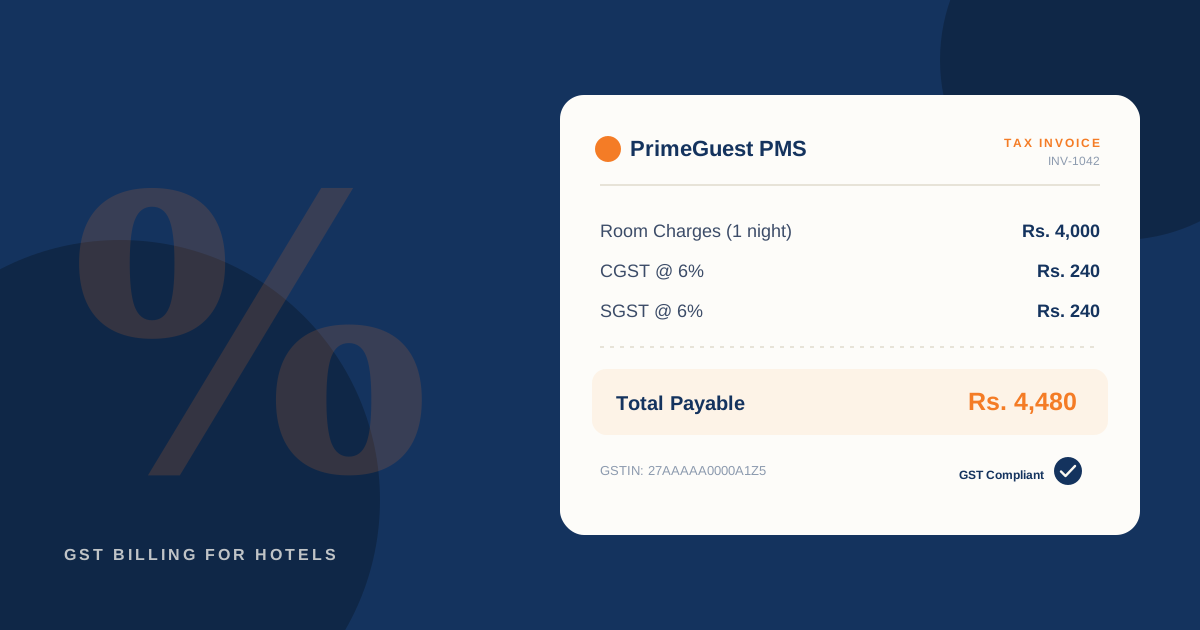
Understanding GST Billing for Hotels
Every rupee a hotel charges a guest, whether for a room, a meal or a late checkout, has to be billed with the correct Goods and Services Tax applied and reported. GST billing for hotels is not just a back-office formality: it is the record that ties a reservation to a payment to a tax return, and it is the first thing an auditor or a corporate guest's finance team will check.
Accurate billing and invoicing matter for two reasons. First, compliance: incorrect tax slabs, missing GSTIN details or unnumbered invoices can mean penalties, blocked input tax credit for corporate guests, and awkward conversations during a GST audit. Second, operations: a hotel that gets billing right, every time, closes folios faster, reconciles bookings against revenue without guesswork, and gives owners numbers they can trust. That is why hotel PMS software with GST built in has become less of a nice-to-have and more of a baseline requirement for Indian hotels.
GST Rates Applicable to Hotel Accommodation
Hotel accommodation in India is taxed on a tariff-based slab structure: the GST rate applied to a room depends on the value actually charged per day, not a flat rate across the board. In broad terms, rooms billed at a lower daily value attract a lower GST slab, while rooms billed above a higher threshold attract a higher slab. Restaurant and food services within a hotel are also taxed differently depending on that same room-tariff structure and on whether the establishment claims input tax credit.
GST slabs and thresholds for hotel accommodation are set by the GST Council and have been revised before. Treat the rate structure above as directional only, always verify the exact rate applicable to your booking date on the official GST portal, a current CBIC notification, or with your chartered accountant before you finalize an invoice or file a return.
This is exactly the kind of rule that a GST compliant hotel software is built to keep current: rather than a front-desk team memorizing thresholds, the system applies the configured slab automatically based on the transaction value of each booking.
What Should a Hotel GST Invoice Include?
A GST-compliant hotel invoice is more than a receipt. At minimum, it should carry:
- Hotel/business name and registered address
- GSTIN of the property
- Guest or customer information, including their GSTIN where the booking is for a business (B2B)
- A unique, sequential invoice number
- Invoice date
- Description of the room type or service billed
- Taxable value (the amount GST is calculated on)
- Applicable GST, split as CGST and SGST for an intra-state stay or IGST for an inter-state supply
- Total invoice value, taxes included
- Any other statutory details required for your state or booking type, such as place of supply
Missing even one of these fields, an unnumbered invoice, or a manually corrected total, is a common reason hotel invoices fail scrutiny during an audit or a corporate reimbursement check.
GST Billing for Hotel Room Bookings
The same room can reach a guest through very different paths, and each one carries its own billing nuance:
- Direct bookings. Billed straight from the property's own systems, with no OTA commission to net out of the taxable value.
- Walk-in guests. Need an invoice generated at, or before, checkout, based on the actual rate charged rather than a rack rate.
- Online bookings. The invoice reflects the amount the hotel actually receives; commission paid to the OTA is a separate transaction and does not reduce the guest-facing taxable value.
- Corporate bookings. Usually need the company's GSTIN and legal name captured accurately so the business can claim input tax credit; getting this wrong is one of the most common corporate-guest complaints.
- Group bookings. May be billed as one consolidated invoice or split per room, depending on how the group's finance team wants to reconcile it, but the tax treatment per room still follows its own tariff.
- Advance payments. An advance or booking deposit can trigger a tax point before the stay happens, so the timing of the invoice matters as much as its content.
- Cancellations. A cancelled booking that was already invoiced typically needs a credit note rather than a simple deletion, so the original invoice and its reversal both stay on record.
- Refunds. Should be tied back to the original invoice and any cancellation charges billed (and taxed) separately from the refunded room value.
Because a single property can run all of these scenarios in the same week, treating billing as a manual, per-booking task is where most errors creep in. It is also why hotel booking software that talks directly to billing, rather than a separate spreadsheet, matters more than it might seem.
GST Billing for Additional Hotel Services
Rooms are rarely the only line item on a guest folio. Food and beverage, room service, laundry, events and banquets, and other on-property services all need to be billed and taxed correctly, and the applicable GST treatment can vary by the nature of the service and by the property's own tariff structure:
- Food & beverage served in the hotel's restaurant
- In-room dining and room service charges
- Laundry and other convenience services
- Events, banquets and conference space rentals
- Spa, recreation and other paid hotel services
GST treatment for these services is not always identical to the room rate, and it can depend on the specific service, the venue, and rules that have been amended over time. Confirm the current treatment for each service category with the latest CBIC guidance or your tax advisor rather than assuming one rate covers everything on the folio.
Common GST Billing Challenges for Hotels
Hotels that still bill manually, or with disconnected tools, tend to run into the same problems on repeat:
- Manual invoice creation that slows down checkout and invites typos
- Incorrect tax calculations when staff apply the wrong slab
- Managing different tax rates across rooms, F&B and other services on one folio
- Billing errors that surface only when a guest, or an auditor, questions the invoice
- Invoice cancellations that are not properly reversed with a credit note
- Refund adjustments that fall out of sync with the original invoice
- Maintaining accurate, audit-ready records across months of transactions
- Managing bookings arriving from multiple channels, each with its own rate and commission logic
- Reconciliation between what was reserved and what was ultimately billed
Individually, each of these looks manageable. Across hundreds of bookings a month, they compound into hours of back-office work and real compliance risk.
How Hotel PMS Software Simplifies GST Billing
This is precisely the gap a modern hotel management software platform is built to close. A hotel PMS with GST billing connects the reservation, the guest folio and the invoice into one workflow, so tax does not depend on someone remembering the current slab at checkout. In practice, that means:
- Automated billing that generates an invoice the moment a folio is closed
- Tax calculations applied automatically based on room tariff and service type
- GST-compliant invoices with every required field populated correctly, every time
- Guest folios that stay accurate as charges, discounts and payments are added mid-stay
- Payment tracking reconciled against invoices, not a separate ledger
- A single booking-to-billing workflow, from reservation through checkout
- Reports built for GST filing, not reconstructed from raw transaction exports
- Accounting workflows that export cleanly instead of needing manual re-entry
- Reduced manual errors, simply because fewer steps are done by hand
PrimeGuest PMS is built around exactly this idea. As an AI-native hotel PMS, it treats billing, bookings and operations as one connected system rather than bolted-together modules, so a booking made on any channel flows straight into a correctly taxed, GST-ready invoice, and the resulting data is already structured for reporting and reconciliation.
Why Hotels Need GST Compliant Hotel Software
Compliance is the obvious reason to invest in the right hotel technology, but it is rarely the only one. GST compliant hotel software also improves billing accuracy by removing manual tax entry, improves operational efficiency by cutting the time front-desk staff spend on invoicing, strengthens reporting by keeping every transaction structured the same way, and reduces the audit burden by keeping records consistent from day one rather than reconstructed at year-end. For a cloud PMS for hotels in particular, this also means the finance function is no longer tied to one server or one laptop at the property, since owners and accountants can review billing and compliance data from anywhere.
Choosing the Right Hotel PMS
Not every property management system is built with Indian tax and distribution realities in mind. When evaluating a hotel PMS software, it is worth checking for:
- GST billing built into invoicing, not added as an afterthought or a third-party plug-in
- Booking management that keeps every channel on one live calendar
- Guest management with a single profile per guest across stays and properties
- Cloud access so owners, managers and accountants can work from anywhere
- Reporting that is ready for both operational reviews and GST filing
- Hotel PMS integrations with OTAs, payment gateways and accounting tools you already rely on
- Automation for repetitive tasks like tax calculation, invoicing and reminders
- Scalability to add rooms, properties or services without switching systems
- Support that understands Indian hotel operations, not a generic global helpdesk
Looking for the best hotel PMS software often comes down to how well these pieces work together, rather than how many features a brochure lists.
Frequently Asked Questions
Simplify Hotel Operations with PrimeGuest PMS
PrimeGuest PMS brings reservations, guests, billing, operations and integrations onto one platform, so hotels run on live data instead of spreadsheets stitched together at month-end.
- AI-native PMS
- Cloud-based hotel management
- Hotel booking management
- GST billing
- Hotel PMS integrations
- Automated workflows
- Real-time visibility