What Is a Hotel Channel Manager?
A hotel channel manager is software that connects a hotel's room availability and rates to the online travel agencies (OTAs) and other channels it sells on, such as Booking.com, Expedia, Agoda, MakeMyTrip and Airbnb. Instead of logging into each extranet to change a rate or close a room, the hotel makes the change once and the channel manager sends it to every connected channel.
It also works in the other direction: when a guest books on an OTA, the channel manager pulls that reservation in and reduces availability everywhere else, so the same room is not sold twice.
How a Channel Manager Works
1. Availability and rates go out
The hotel sets how many rooms of each type are available and at what rate. The channel manager maps each room type and rate plan to its equivalent on every OTA and pushes the updates.
2. Bookings come in
When a booking, modification or cancellation happens on any channel, it is delivered to the hotel's system and the remaining inventory is updated across all channels.
3. Restrictions are kept consistent
Minimum stays, closed-to-arrival dates and stop-sells set once apply everywhere, which matters most on peak dates and long weekends.
Why Overbookings Still Happen
Most overbookings are not caused by OTAs, but by the gap between systems. In a typical setup, the channel manager and the PMS are separate products from separate vendors, connected by an integration. If that sync is delayed or fails, a room sold on one channel can still look available on another for a few minutes, and on a busy night a few minutes is enough.
Other common causes are room types mapped incorrectly between systems, and manual changes made directly in an OTA extranet that the channel manager never sees.
Do You Need a Separate Channel Manager?
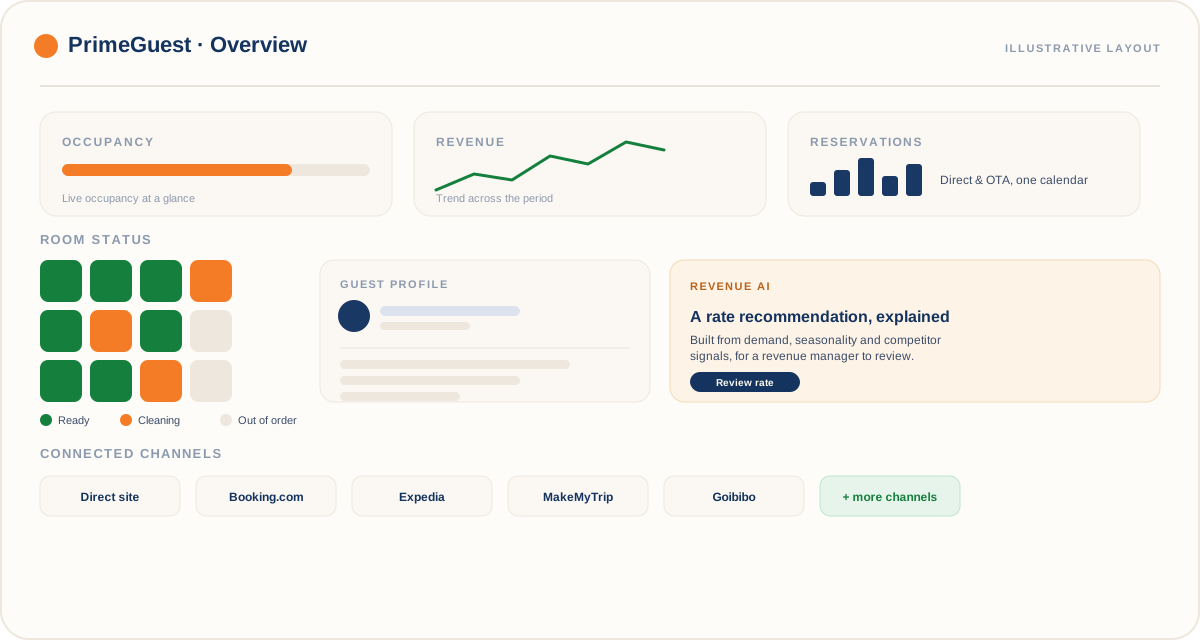
If your PMS has no distribution built in, yes: managing several OTAs by hand does not scale past a handful of rooms. But a separate channel manager is not the only option. Some hotel platforms include channel management inside the PMS itself, so OTA bookings, direct bookings and walk-ins all live on one calendar with no middleware in between.
Weigh the two approaches like this:
- Separate channel manager: a good fit if you are happy with your current PMS and only need distribution. Expect a second subscription, a second login, and an integration to keep healthy.
- Built-in channel management: one system, one calendar and one bill, with no sync between vendors. Check that it connects to every channel that matters to you before switching.
PrimeGuest takes the second approach: its channel manager is part of the platform, and if a hotel already uses a channel manager it likes, PrimeGuest integrates with it instead. You can browse supported channels on the integrations page.
Features to Look For
- Real-time, two-way sync of availability, rates and restrictions
- The channels you actually sell on, including India-focused OTAs, not just global ones
- Rate plans and derived rates (for example, a non-refundable rate set as a percentage of the base rate)
- Bulk updates across date ranges and room types
- Channel performance reports showing bookings, revenue and commission cost by channel
- A booking engine on the same calendar so direct bookings follow the same inventory
- Pricing support that suggests rate changes based on demand, as covered in how AI pricing works for hotels
Channel Manager Best Practices
- Make every rate and availability change in one place, never directly in an OTA extranet.
- Review room type mapping whenever you add a room type or rate plan.
- Keep rate parity sensible across channels, and give direct bookers a reason to book with you.
- Check channel reports monthly to see which OTAs bring profitable bookings after commission.
- Grow direct bookings alongside OTAs; our guide on how to increase direct hotel bookings covers the practical steps.
New to hotel software terms? Start with what a hotel PMS is and how it fits with a channel manager.
Frequently Asked Questions
Simplify Hotel Operations with PrimeGuest PMS
PrimeGuest PMS brings reservations, guests, billing, operations and integrations onto one platform, so hotels run on live data instead of spreadsheets stitched together at month-end.
- AI-native PMS
- Cloud-based hotel management
- Hotel booking management
- GST billing
- Hotel PMS integrations
- Automated workflows
- Real-time visibility