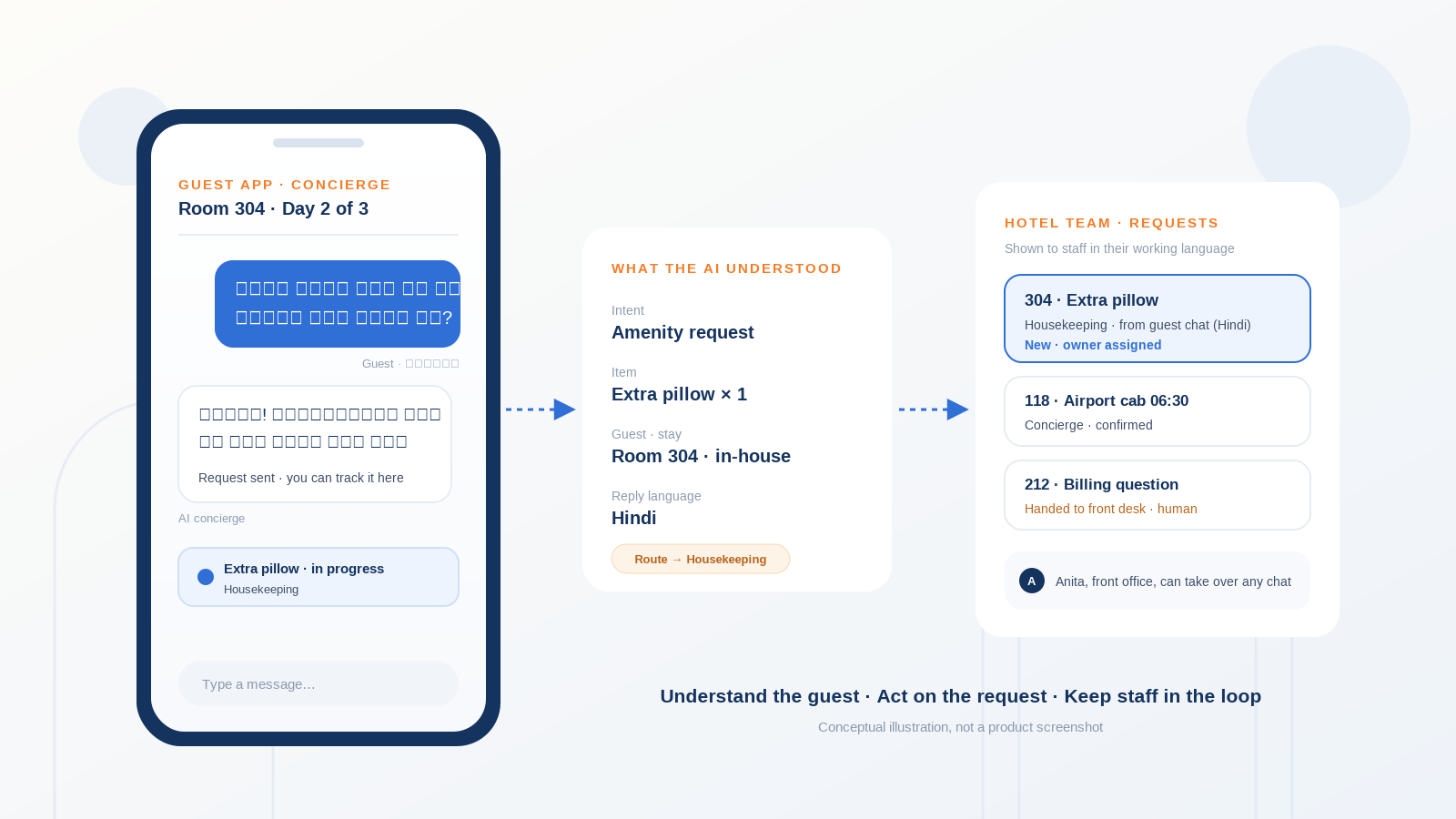
On any given evening, the same hotel might be welcoming a family from Kolkata on a first trip to Rajasthan, a couple from France checking into a houseboat stay in Kerala, a group of cousins travelling across South India with three different first languages between them, and a business traveller from Seoul arriving late in Bengaluru. Each of them expects the same thing: to be understood.
India recorded about 4.29 billion domestic tourist visits in 2025, according to Ministry of Tourism data published in 2026, a figure lifted by the Maha Kumbh, alongside roughly 9 million foreign tourist arrivals. Globally, UN Tourism estimates that around 690 million tourists travelled internationally in the first half of 2026 alone, after about 1.54 billion international arrivals in 2025. And domestic travel in India is itself multilingual: the 2011 Census recorded 121 languages, 22 of them in the Eighth Schedule of the Constitution.
Guest expectations have shifted with this diversity. Travellers now expect quick, convenient, personalised communication, increasingly on their phones, and ideally in a language they are comfortable with. For hotels, the challenge is delivering that consistently when every guest’s language preference and communication style is different, and when the team on shift cannot speak every language.
This is where multilingual AI for hotels is changing the picture. Not by translating words more quickly, but by helping hotels understand what a guest needs, respond in context, and connect the conversation to the service that follows.
Multilingual AI guest communication uses conversational AI to understand what a guest is asking in their preferred language, answer from the hotel’s own information, and turn requests into tasks for the right team. Unlike a translation tool, it works with intent and context, and it should hand over to hotel staff whenever a situation needs human judgement.
Changing Guest Expectations: Communication Is Part of the Guest Experience
Guest communication used to be treated as a support function: answer the phone, take the request, pass it on. Today it is part of the product. How quickly and clearly a hotel responds shapes how confident a guest feels about the booking, the stay and the decision to return.
Several shifts are driving this:
- More diverse travellers. Growth in domestic leisure travel, pilgrimage tourism, destination weddings and international arrivals means hotels in every segment serve guests from more regions and language backgrounds.
- Instant-response habits. Guests who use messaging apps all day expect a quick reply, not a callback when the desk is free.
- Digital convenience. Checking in, asking for towels or booking a cab from a phone is increasingly normal, especially for younger and business travellers.
- Preference for familiar languages. In a 2020 survey of 8,709 consumers in 29 countries, CSA Research found that 76% preferred buying products with information in their own language. The study looked at online shopping rather than hotels, but the principle carries over: people feel more confident acting on information they fully understand.
- Accessibility and inclusion. Clear communication matters for older guests, first-time travellers and anyone less comfortable in English, not only for international visitors.
Language should not become a barrier between a hotel and its guests. A guest who has to struggle to explain a simple request, or who gives up asking, has a weaker experience even if the room itself is excellent.
Where Traditional Hotel Communication Faces Challenges
Most hotels manage language differences through the people they hire and the goodwill of their teams. That works up to a point, but it has natural limits.
Dependence on Multilingual Staff
A resort in Goa may have staff who speak Konkani, Hindi, English and some Russian. A hotel in Kochi may have a manager fluent in Arabic. But no property can staff every language across every shift, and the colleague who speaks a guest’s language is rarely on duty at 2 am. Multilingual staff are valuable precisely because they are scarce.
Communication Gaps at the Front Desk
Misunderstandings tend to cluster around the moments that matter most: deposits and ID rules at check-in, what is included in a package, how a bill has been calculated, or what “late checkout subject to availability” really means. A guest who nods politely without fully understanding may only discover the gap at checkout, when it is harder to fix.
Delayed Responses to Guest Requests
When a guest and staff member do not share a language comfortably, simple requests take longer. A phone call to the desk becomes a repeated explanation, then a note passed to housekeeping, sometimes with details lost along the way. Each handover adds delay, and the guest has no visibility of whether the request was understood.
Inconsistent Guest Experiences
When communication quality depends on who happens to be on shift, two guests in the same hotel can have very different stays. The quality of a hotel’s communication should not rest entirely on staff availability or individual language skills. That is a system problem, and it deserves a system answer.
Beyond Translation: How AI Is Transforming Guest Communication
Translation tools have been available to hotels for years. They are useful, but they solve a narrow problem: converting words from one language to another. Hospitality needs something broader. When a guest writes “we’re arriving around midnight, will someone be there?”, the useful response is not a translation. It is an answer about the night desk, a note on the reservation, and perhaps an offer to arrange a transfer.
Conversational AI, built on modern natural language processing and large language models, can work at this level. In practice, it can:
- Understand intent, not just words. “It’s too cold in here” and “can you send someone to look at the AC?” point to the same need.
- Respond in context. The right answer about breakfast depends on whether the guest’s rate includes it.
- Hold multilingual conversations. A guest can write in their preferred language, switch mid-conversation, or mix languages, as many guests in India naturally do.
- Handle common enquiries automatically. Wi-Fi, timings, directions and policies, answered instantly from approved hotel information.
- Personalise assistance. Using what the guest has already shared, such as travelling with an infant or arriving late, to make the next answer more relevant.
- Keep conversational context. “Can you make that 8 instead?” is understood as changing the cab booking mentioned earlier.
- Escalate to people. Recognising when a request is complex, sensitive or unclear, and handing it to the right staff member with the conversation attached.
| Translation tool | Conversational AI | |
|---|---|---|
| What it works with | Words and sentences | The guest’s intent, plus the context of their stay |
| Typical output | The same message, in another language | An answer, a clarifying question, or an action |
| Memory | Each message handled on its own | Keeps the thread of the conversation |
| Hotel knowledge | None; it does not know your policies | Can draw on approved hotel information, if connected |
| Follow-through | Someone still has to act on the message | Can create and route a request to the right team |
| When it is unsure | Returns a translation regardless | Should ask, or hand over to a person |
What AI Still Gets Wrong
Multilingual AI is impressive, but it is not perfect, and hotels should plan around its limits:
- Uneven language quality. AI tends to perform best in widely used languages and can be weaker in languages with less training data, regional dialects or heavy code-mixing.
- Cultural nuance. Politeness, formality and indirect requests vary across cultures. A literal reading can miss what a guest actually means.
- Confident mistakes. AI can produce fluent answers that are wrong. It should answer from approved hotel information and say when it does not know.
- Sensitive situations. Complaints, medical concerns, safety issues and billing disputes need a person, not an automated reply.
Practical takeaway: treat multilingual AI as a capable first responder, not the final word. Set clear rules for what it can answer, test it in the languages your guests actually use, and make handover to a person easy and fast.
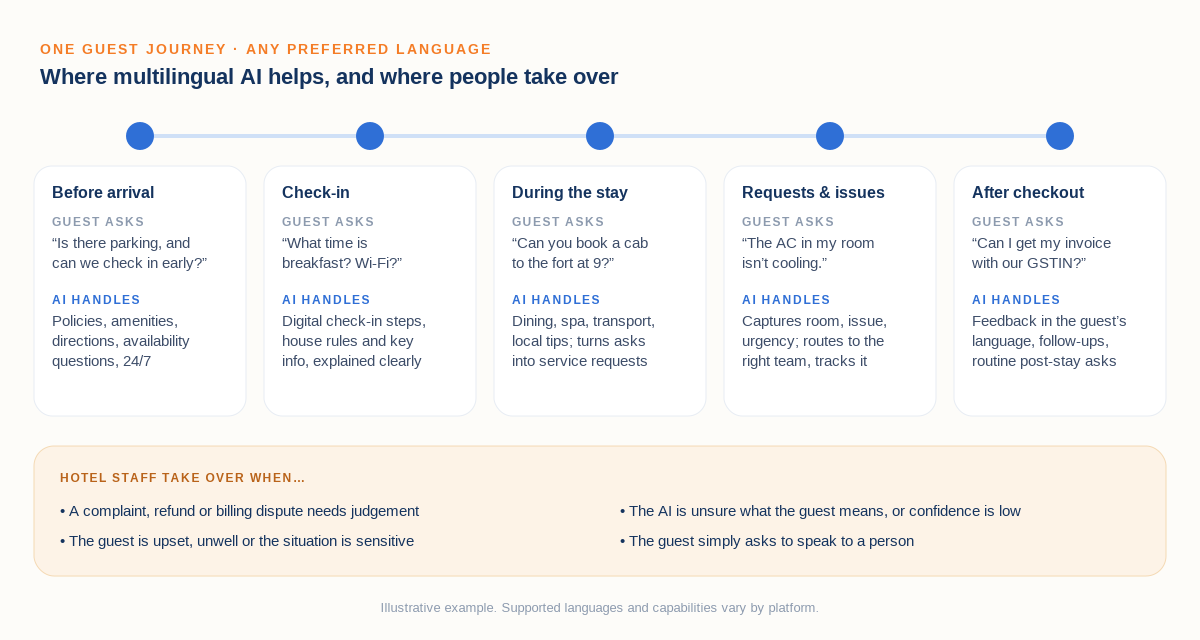
One Guest Journey, Multiple Languages: Where AI Makes a Difference
An AI concierge for hotels is most useful when it supports the whole stay, not a single moment. Here is how multilingual assistance can fit each stage of the guest journey.
Before Arrival: Enquiries and Booking Assistance
Most guest communication starts before anyone reaches the property. A family in Chennai planning a week in Munnar wants to know whether the resort has a children’s pool, whether the road is manageable after dark, and whether an extra bed is possible. A traveller from Germany booking a heritage hotel in Jaipur wants to confirm airport transfers and the cancellation policy.
A multilingual AI concierge can answer these questions in the guest’s preferred language at any hour, using the hotel’s own approved information about room types, amenities, check-in times and directions. When a question depends on live availability or a special arrangement, the right behaviour is to confirm what it can and pass the rest to reservations, rather than guess.
At Check-in: Making First Interactions Easier
Check-in is where small misunderstandings become lasting impressions. Deposit rules, ID requirements, breakfast timings, Wi-Fi access and house policies are often explained quickly, in one language, at a busy desk.
When guests can complete digital check-in and read key information in a language they are comfortable with, the conversation at the desk becomes a welcome rather than a form-filling exercise. A guest who has already understood the policies tends to arrive with fewer questions, and front-office staff can spend those minutes on hospitality instead of repetition.
During the Stay: A More Accessible Concierge Experience
Most in-stay questions are simple, frequent and time-sensitive. Multilingual AI is well suited to them:
- Room service: what is on the menu, whether a dish can be made less spicy, how long it will take.
- Housekeeping: extra towels, a cot for a baby, a later cleaning slot.
- Restaurant timings: when the rooftop restaurant opens, whether a table is needed.
- Spa and facilities: pool hours, gym access, treatment slots.
- Transport: a cab to the station, a driver for a day of sightseeing.
- Local attractions: how far the fort is, the best time to visit, what to wear to a temple.
- General enquiries: laundry, currency exchange, late checkout.
Consider a couple from Kolkata on their first visit to a resort in Udaipur. They are comfortable in Bengali and English, the night team is most comfortable in Hindi and English, and it is 11 pm. A concierge that understands what they are asking, answers in a language they can read, and quietly creates a request for the team means nobody has to struggle through a phone call to get a kettle replaced.
Guest Requests and Issue Resolution
This is where understanding matters more than translation. When a guest writes “the AC isn’t cooling and we have a baby with us,” a good system should recognise a maintenance issue, note the room, sense the urgency, and create a task for the right team, while letting the guest know it has been passed on.
Capturing the room number, the problem, the time and any relevant detail at the point of contact removes the back-and-forth that usually slows things down. The request can then be tracked to completion, and if it is running late, escalated before the guest has to ask twice. Complaints, refunds and anything sensitive should go straight to a person.
After Checkout: Continuing the Conversation
Feedback is more honest and more detailed when guests can write it in the language they think in. Inviting feedback in the guest’s preferred language, and summarising it for managers in theirs, helps hotels hear from guests who might otherwise skip the survey.
Post-stay communication, such as sending an invoice, answering a lost-property query or sharing a personalised offer for a return visit, works the same way. Preferences captured during the stay, like a request for a high floor or a vegetarian breakfast, can make the next welcome more personal, provided guests have been told how their data is used.
AI and Human Collaboration: The Future of Hotel Service
The strongest case for AI in hotel guest services is not replacing people. It is giving people back the time and context to do the parts of hospitality that only people can do. Guests appear to agree: in a Mews survey of 3,250 travellers, reported by Hotels magazine, 89% preferred either a hybrid experience or AI working behind the scenes on repetitive tasks, rather than an AI-led stay.
A sensible division of work looks like this:
- AI handles the routine. Timings, directions, Wi-Fi, simple amenity requests and status updates, in the guest’s language, at any hour.
- Staff focus on the complex. Special occasions, group arrangements, VIP guests and anything that needs judgement or creativity.
- People own the sensitive moments. Complaints, refunds, health or safety concerns, and any guest who asks to speak to someone.
- Staff get better context, faster. When a conversation is handed over, the team sees what was asked, what was answered and what the guest needs, without asking them to repeat it.
- Departments stay coordinated. Requests reach housekeeping, maintenance or the concierge directly, with status the front desk can see.
Done well, technology makes hospitality more human, not less. A front-office manager who is not answering the same Wi-Fi question for the fortieth time is a manager who has time to greet a returning guest by name.
The Business Benefits of Multilingual AI for Hotels
The practical value of multilingual AI guest communication shows up in day-to-day operations. The size of the impact depends on the property, its guest mix and how well the system is set up, but the main benefits are consistent:
Guests who are not comfortable in the front desk’s language can still get answers and make requests with confidence.
Routine questions are answered immediately, at any hour, instead of waiting for the right staff member to be free.
Every guest receives the same approved answer on policies and timings, whatever language they ask in.
Fewer repeated phone calls, fewer misread notes, and fewer requests lost between the desk and a department.
Teams spend less time on repetitive questions and more on the guests and moments that need them.
Night shifts with small teams can still offer a responsive digital concierge without hiring for every language.
Preferences and context captured in conversation can inform how the hotel serves the guest later in the stay and on return visits.
One approach serves domestic guests from different states and international guests alike, instead of separate workarounds.
These are operational benefits, not guaranteed outcomes. Measure response times, request completion and guest feedback before and after introducing AI to understand its real effect at your property.
Why Connected AI Matters More Than an Isolated Chatbot
Many hotels already have a multilingual hotel chatbot on their website. It can answer FAQs in several languages, which is a start. But a standalone chatbot that cannot see the reservation, does not know the guest is in-house, and cannot create a task for housekeeping still leaves the real work to someone else. The guest is understood, but nothing happens.
The difference between a chatbot and a useful AI-powered hotel concierge is what the AI is connected to:
Answers drawn from the hotel’s own approved policies, timings and services, not generic internet knowledge.
A request made in conversation becomes a real task with an owner, not a message someone has to copy elsewhere.
Housekeeping, maintenance and the front desk see the same request, in their own working language.
Room, issue, urgency and timing captured once and routed to the right team, with status the guest can follow.
The website, guest app and messaging channels give the same answers because they draw on the same source.
Reservations, guest profiles and billing connected to the conversation, so context does not have to be re-entered.
This is the same principle we explore in AI-native vs AI-enabled hotel software: AI is most useful when it works from the same data and workflows as the rest of the hotel. For guest communication, that means the next generation of hotel communication technology combines intelligent conversation with connected operations, built around a hotel PMS that holds the reservation, the room and the guest record.
How PrimeGuest Is Bringing AI into Modern Guest Experiences
PrimeGuest is an AI-native hotel management platform built for modern hospitality, with guest communication designed to sit on the same live record as the rest of hotel operations rather than in a separate tool.
- Guest App. The PrimeGuest Guest App opens from a link with nothing to install, so guests can check in from their phone, ask questions, accept upgrades and pay by UPI.
- AI Concierge. A 24/7 AI concierge inside the guest app answers common questions, such as extra towels, late checkout or pool timings, in the language your guest speaks.
- Connected guest services. Requests made in the guest app become routed, tracked tasks with an owner and a deadline, escalate before they become complaints, and show their status to the guest.
- One shared record. Every guest message updates the same record the front desk sees, and preferences captured in conversation can be saved to the guest profile for future stays.
- Connected operations. Requests reach housekeeping and other teams through the same platform that runs the PMS, channel manager and direct booking engine.
The aim is the one this article describes: moving guest communication from answering messages towards understanding guests and getting things done for them.
Available modules, languages and features can vary by plan. Talk to the PrimeGuest team to confirm what is included for your property.
The Future of Hospitality Has No Language Barrier
Hotels have always served guests from far away. What is changing is the scale and the expectation. More people are travelling, across more languages, and they expect the hotel to meet them where they are: on their phone, at any hour, in words they understand.
AI gives hotels a practical way to do this without hiring for every language or leaving the night team to manage alone. But the real opportunity is not simply translating conversations. It is understanding guests, anticipating what they need, and connecting each conversation to the service that follows, with people stepping in whenever it matters.
Great hospitality is not about speaking the same language. It is about making every guest feel understood.
See how PrimeGuest connects guest conversations to hotel operations.
- Ministry of Tourism, Government of India: Tourism Footfall and Receipts, World and India (2026)
- Ministry of Tourism, Government of India: India Tourism Dashboard (foreign tourist arrivals, 2025)
- UN Tourism: World Tourism Barometer, September 2026 (excerpt)
- Office of the Registrar General, Census of India 2011: Language (Table C-16)
- CSA Research: Consumers prefer their own language (Can’t Read, Won’t Buy – B2C, 2020)
- Hotels magazine: Mews reports that guests prefer humans over AI after all
You May Also Like
Why where AI sits in your hotel platform matters as much as what it can do.
Read more →The system of record behind reservations, rooms, billing and guest information.
Read more →Practical ways to win more bookings through your own website and booking engine.
Read more →Frequently Asked Questions
Simplify Hotel Operations with PrimeGuest PMS
PrimeGuest PMS brings reservations, guests, billing, operations and integrations onto one platform, so hotels run on live data instead of spreadsheets stitched together at month-end.
- AI-native PMS
- Cloud-based hotel management
- Hotel booking management
- GST billing
- Hotel PMS integrations
- Automated workflows
- Real-time visibility