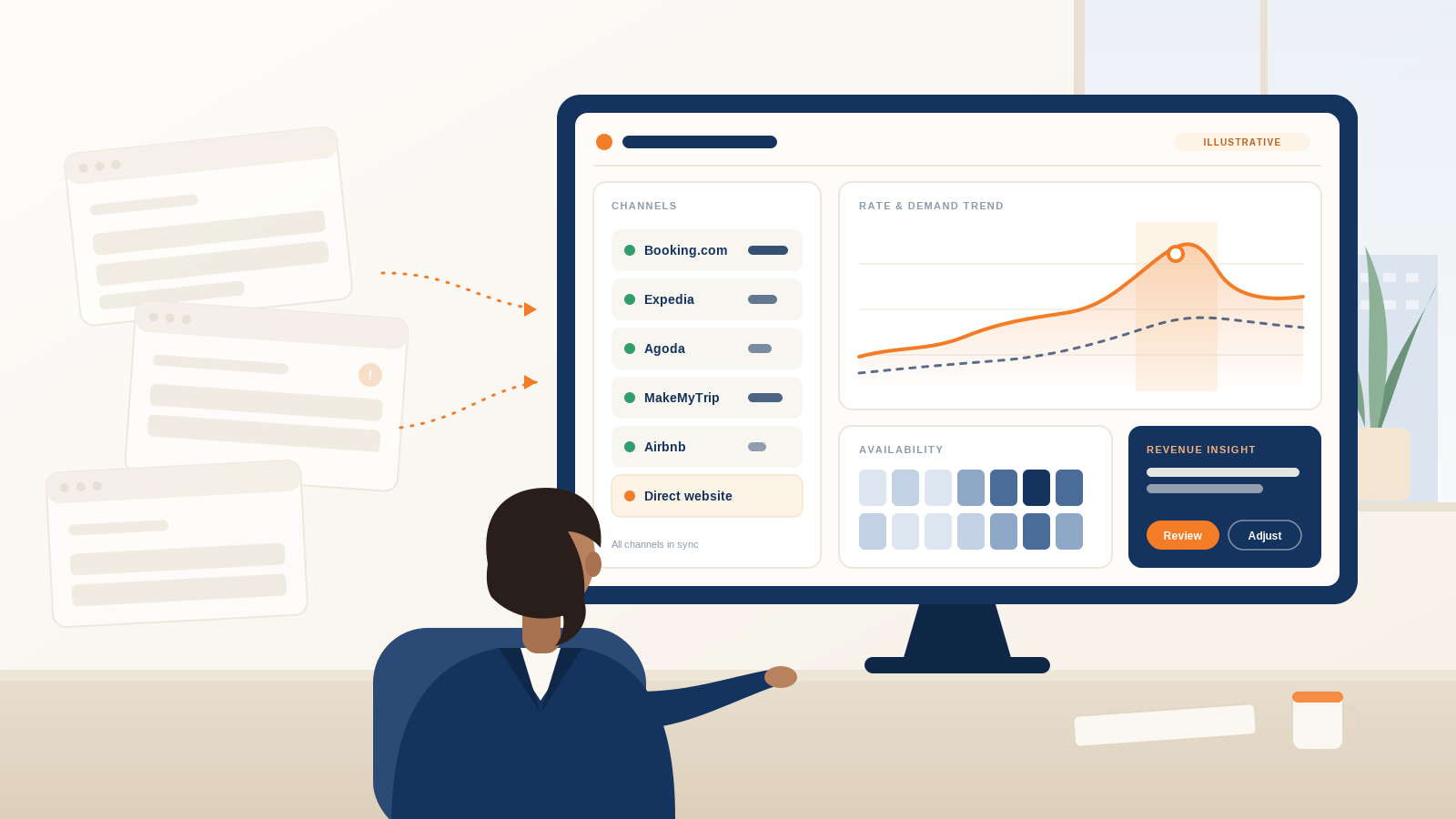
Hotel Channel Management Is Changing
For most of the last two decades, hotel channel management meant one thing: making sure the rate and the number of rooms a hotel showed on Booking.com matched what it showed on Expedia, Agoda, MakeMyTrip and everywhere else it sold. It was a hard, unglamorous problem, and channel managers solved it well. A reservations team that once lived inside half a dozen extranets could finally make a change once and trust it to appear everywhere.
That problem has not gone away, but it is no longer the interesting one. Keeping inventory in sync is now table stakes. What hotel teams need today is visibility: how demand is building for each date, which channels are actually producing profitable business, what a room should cost next Saturday, and where the last ten rooms on a sold-out night should be sold. In other words, the job of the hotel channel manager is moving from distribution plumbing towards revenue strategy.
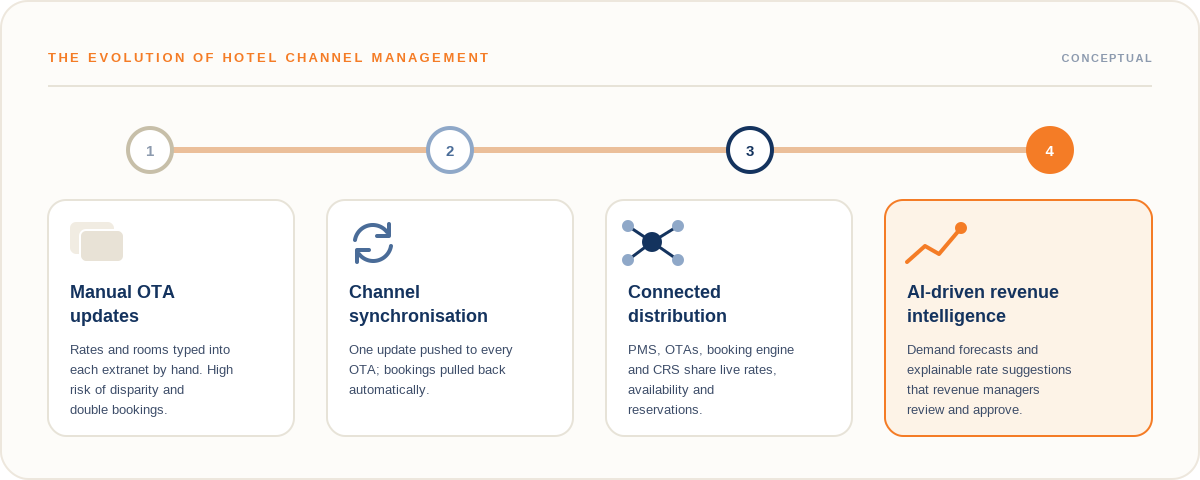
The Early Days of Hotel Channel Management: Solving the Distribution Problem
Anyone who worked a reservations desk before channel managers were common will remember the routine. Every OTA had its own extranet, its own login and its own way of describing a room. Changing the weekend rate meant opening each one in turn and typing the same number again. Closing a room type for a sold-out date meant doing it everywhere, quickly, before someone else booked it.
The consequences were predictable:
- Inconsistent rates and availability. A rate updated on three channels and forgotten on the fourth undercut the hotel on its own inventory.
- Double bookings and overbooking. The last room could be sold on two channels in the minutes before anyone noticed, leaving the front desk to walk a guest on arrival.
- Slow reservation reconciliation. Bookings arrived by email or fax and were keyed into the property system by hand, with every modification and cancellation adding another chance for error.
- Conservative selling. To avoid overbooking, many hotels held back rooms from OTAs altogether, leaving inventory unsold on nights it could have filled.
The hotel channel manager answered this with a simple idea: one central place to set rates, availability and restrictions, connected to each OTA so that updates flow out and reservations flow back in automatically. It reduced operational complexity, made distribution far more accurate, and gave smaller hotels the confidence to sell on many more channels than they could manage by hand. For a long time, that alone was reason enough to buy one.
From Inventory Synchronisation to Connected Hotel Distribution
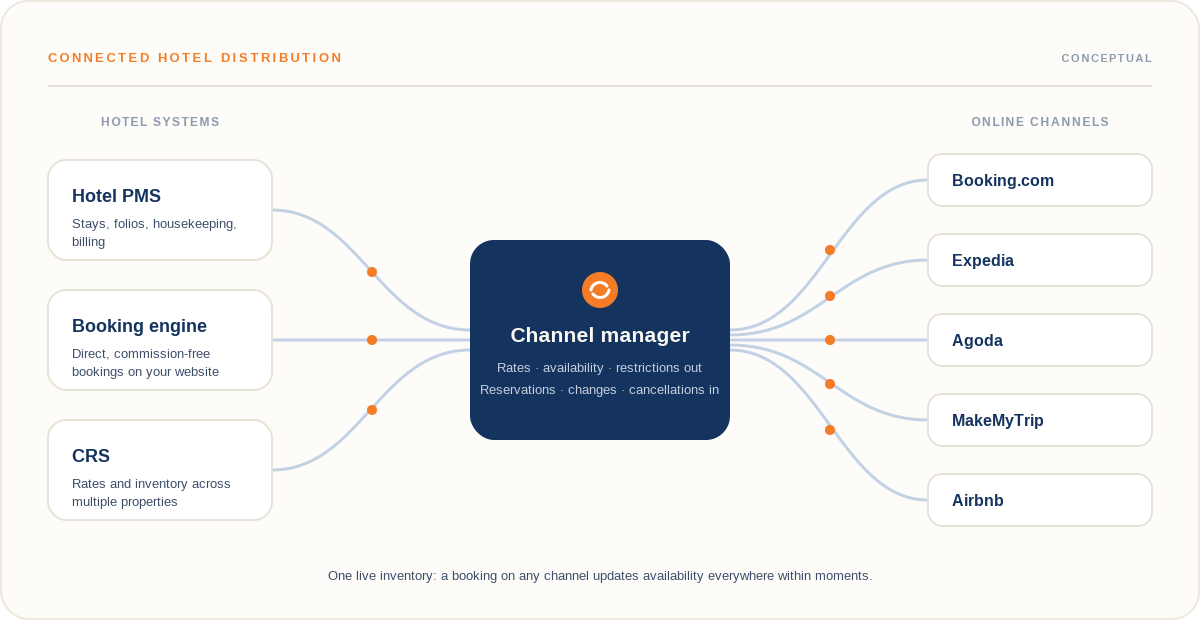
Hotel distribution has since become a network rather than a list of OTAs. A modern hotel channel manager sits at the centre of several systems that all need the same version of the truth:
- Online travel agencies and distribution partners such as Booking.com, Expedia, Agoda, MakeMyTrip, Goibibo, Yatra and Hotelbeds, each with its own room mapping, rate plans and promotions.
- The hotel’s direct booking engine, selling commission-free on its own website.
- A central reservation system (CRS) for groups that manage rates and inventory across several properties.
- The property management system, where the reservation becomes a stay, a folio and eventually a GST invoice.
- Vacation rental channels such as Airbnb, Vrbo and Ministry of Villas, increasingly relevant for boutique properties, villas and serviced apartments.
When all of these share live rates, availability and reservations, a booking on any one channel updates the rest within moments, and the front desk, housekeeping and accounts teams work from the same record. When they do not, the gaps show up as overbookings, rate disparities that undercut the hotel’s own website, and hours spent reconciling reports that never quite agree. This is why hotel PMS integration has become one of the most important questions in channel management. The tighter the link between distribution and the hotel PMS, the fewer places for the truth to drift.
The Shift from Rate Updates to Revenue Strategy
Here is the uncomfortable truth about rate synchronisation: it distributes whatever number it is given. A hotel channel manager will faithfully publish the wrong rate to fifteen channels just as quickly as the right one. Synchronisation is the starting point. The real opportunity lies in knowing what that rate should be, and where each room is best sold.
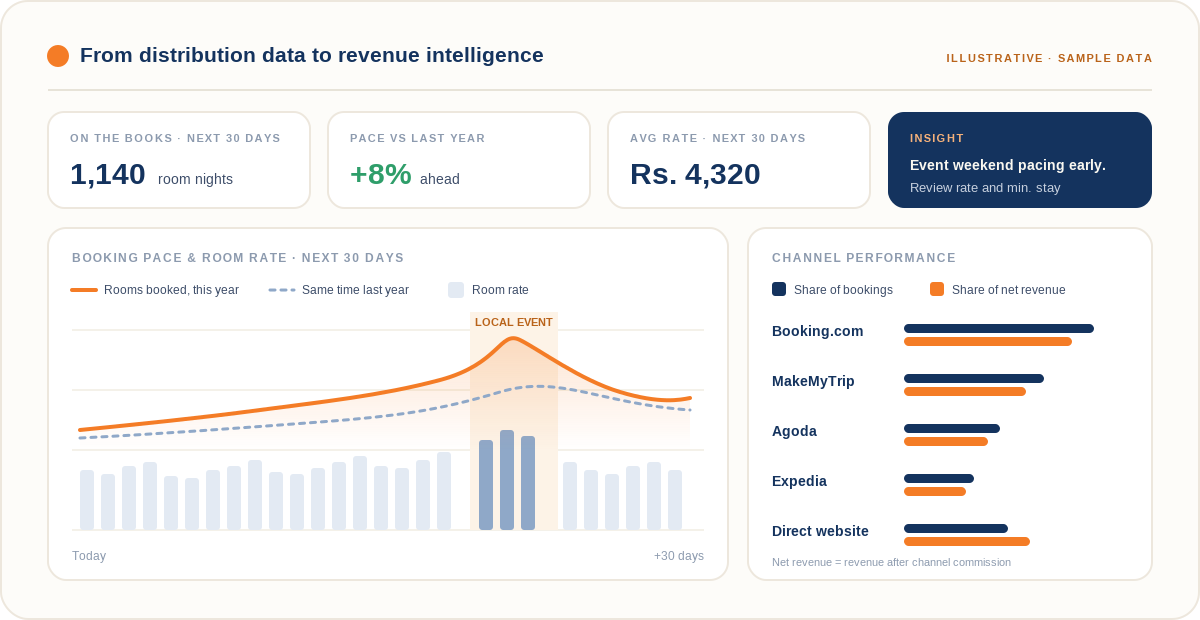
Because the channel manager already sees every reservation from every channel, it sits on exactly the data that hotel revenue management depends on. The shift happening now is from using that data only to move inventory, to using it to answer commercial questions:
Booking pace and demand patterns
Is next month filling faster or slower than it usually does at this point? Pace, not today’s occupancy, is usually the earliest sign that a rate is too high or too low.
Seasonality
Wedding season, school holidays, monsoon lulls and long weekends repeat every year. Rates set ahead of those patterns tend to outperform rates changed after the fact.
High-demand periods and local events
A trade fair, cricket match or festival can lift demand for two or three specific nights. Spotting them early matters more than reacting the week before.
Channel performance
Which channels deliver which guests, for which stay dates, at what lead time and with what cancellation behaviour? Not every booking is worth the same.
The true cost of each booking
An OTA booking carries a commission; a direct booking carries marketing and payment costs. Comparing net revenue, not just rate, changes how inventory gets allocated.
Inventory allocation
On a compression night, should the last rooms go to the channel with the highest rate, the lowest cost, or the guest most likely to return? That is a revenue decision, not a sync.
Consider a 60-room city hotel three weeks out from a large trade exhibition. A pure synchronisation mindset notices nothing until rooms start disappearing. A revenue mindset notices that pace for those dates is running ahead of the same period last year, that most of the early pickup is coming through one OTA at long lead times, and that the direct channel has barely moved. The decision that follows (raise the rate, add a minimum stay on the peak night, hold some inventory back for higher-value direct guests) is still made by a person. But it can only be made well if the distribution data is visible in the first place.
How AI Is Transforming Hotel Channel Management
The amount of data a connected distribution setup produces is more than most hotel teams can read every day. That is where AI and automation are changing the work, not by replacing the revenue manager, but by doing the reading, pattern-spotting and repetitive steps that crowd out actual decision-making.
- Demand forecasting. Projecting how each future date is likely to book, based on historical patterns and current pace.
- Pricing recommendations. Suggesting a rate per date and room type, with the reasons behind it, such as strong pace, a nearby event or a shift in the market.
- Seasonal and market trend analysis. Recognising recurring peaks and lulls early enough to price ahead of them.
- Spotting pricing opportunities. Flagging dates where demand and rate look out of step, in either direction, before the window to act closes.
- Reducing repetitive tasks. Rate loading, restriction updates and routine reports that once took hours of manual work.
- Connecting operational and revenue intelligence. Using what the PMS knows about stays, cancellations and guest history to inform distribution decisions.
AI-assisted, not autopilot
There is an important distinction between AI-assisted decision-making and fully autonomous pricing. An AI hotel channel manager worth trusting explains its recommendations and leaves the final call with the people who understand the property: its positioning, its corporate contracts, its relationship with a wedding planner who books every December. Those are things a model cannot fully see. Our guide to AI pricing for hotels explores how these recommendations are built.
The healthiest model is a partnership: AI surfaces the signal and proposes a rate; a revenue manager reviews, adjusts or overrides it; the hotel channel manager distributes the decision everywhere at once.
The Growing Importance of Direct Bookings and Distribution Balance
OTAs are powerful distribution partners. They reach travellers no independent hotel could reach alone, and for many properties they remain the largest single source of business. But every OTA booking carries a commission, and a hotel that relies too heavily on one or two platforms has less control over its pricing, its guest relationships and its margins.
A healthy hotel distribution strategy is therefore about balance rather than choosing sides. OTAs bring in new guests; the hotel’s own website wins repeat guests, local demand and travellers who look the hotel up after finding it elsewhere. For that to work, the hotel booking engine has to be a first-class channel, sharing the same live inventory and rate plans as every OTA, rather than an afterthought that shows stale availability or a rate higher than Booking.com.
Rate and availability consistency across direct and indirect channels matters here too. It protects trust with guests who compare prices, keeps the hotel aligned with its OTA agreements, and makes it possible to offer direct-booking perks without undercutting itself. Our article on increasing direct hotel bookings covers the practical steps.
What Modern Hotels Should Expect from Hotel Channel Management Software
If you are evaluating hotel channel management software today, the checklist has grown well beyond the number of OTA connections. These are the capabilities worth asking every vendor to demonstrate with your own room types and rate plans:
- Real-time rate and availability synchronisation
Changes and bookings should reach every connected channel quickly and reliably, with clear alerts when a connection fails.
- Centralised reservation management
OTA, direct, phone and walk-in reservations in one place, so modifications and cancellations are never reconciled by hand.
- Seamless PMS integration
Ideally one shared inventory calendar rather than two systems kept in step by an interface that can drift.
- An integrated direct booking engine
The hotel’s own website should sell from the same live inventory and rate plans as every OTA.
- Distribution performance visibility
Production by channel, lead time, length of stay, cancellations and net revenue after commission, without exporting to spreadsheets.
- Revenue intelligence and AI-assisted pricing
Explainable rate recommendations grounded in pace, seasonality and market data, which a person can approve, adjust or override.
- Multi-property management
Rates, restrictions and reporting across a group from one login, while each property keeps its own local strategy.
- Reliable connectivity and automation
Stable OTA connections, accurate room and rate mapping, and automation for repetitive tasks, with a human able to step in.
For hotels in India, add local requirements to the list: connections to the OTAs your market actually books through, UPI and card payments, and billing that stays compliant from booking to invoice. Our guide to GST billing rules for hotels in India explains why that last step matters more than it first appears.
The Future: Channel Management as Part of an Intelligent Hotel Operating System
The direction of travel is clear. Channel management is no longer an isolated tool bolted onto the side of a hotel’s systems. It is becoming one part of a connected ecosystem in which distribution, reservations, pricing, guest management, billing and revenue intelligence work from the same data and inform each other.
In that model, a booking on MakeMyTrip does not just reduce availability. It updates the pace forecast, informs the next rate recommendation, creates the guest profile the front desk will greet at check-in, and flows through to a compliant invoice at checkout. Each step is visible to the people who need it, and each decision can draw on everything the hotel knows.
This is the thinking behind AI-native hotel platforms, where intelligence is designed into the core rather than added as a separate module. PrimeGuest is built this way: a cloud PMS, hotel channel manager, direct booking engine, centralised distribution, AI-assisted revenue intelligence and GST-compliant billing and payments, designed together for modern Indian hospitality, with revenue managers firmly in control of the decisions.
Conclusion
Channel managers earned their place by solving a genuine distribution problem, and accurate, real-time synchronisation remains essential. But the hotels that will compete best over the next decade are those that treat distribution data as strategic data. The next generation of hotel channel management will not simply help hotels distribute rooms faster. It will help them make smarter decisions about pricing, distribution and revenue.
Ready to move beyond rate updates?
Discover how PrimeGuest helps hotels connect distribution, operations and revenue intelligence in one AI-native platform.
You May Also Like
How AI reads demand, seasonality and competitor rates to recommend smarter room rates.
Read more →How OTA sync works, why overbookings still happen, and which features matter.
Read more →Seven practical steps to win more direct bookings without leaving OTAs.
Read more →Frequently Asked Questions
Simplify Hotel Operations with PrimeGuest PMS
PrimeGuest PMS brings reservations, guests, billing, operations and integrations onto one platform, so hotels run on live data instead of spreadsheets stitched together at month-end.
- AI-native PMS
- Cloud-based hotel management
- Hotel booking management
- GST billing
- Hotel PMS integrations
- Automated workflows
- Real-time visibility