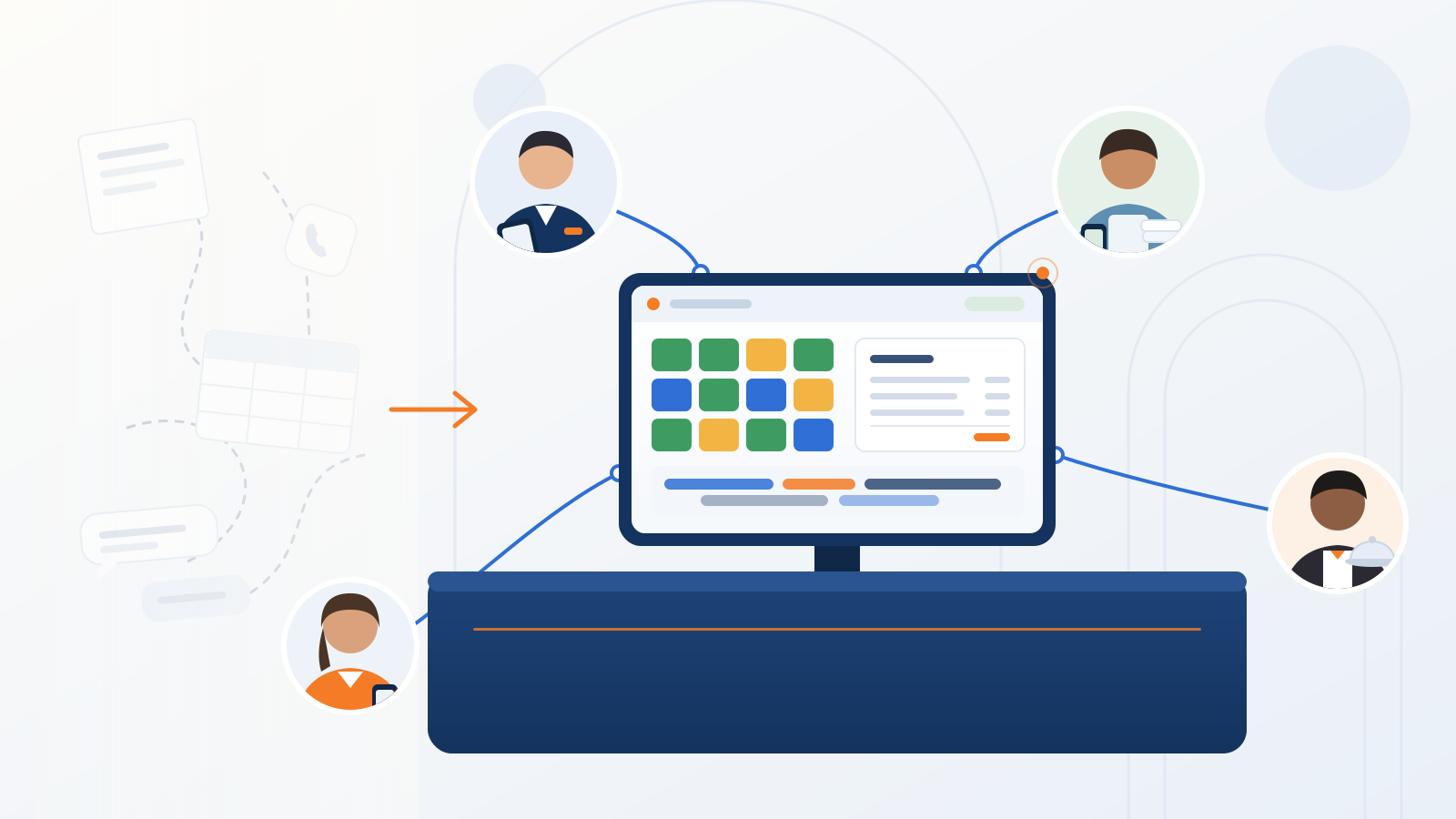
Most hotels do not have a technology shortage. They have a connectivity problem. The front desk runs a property management system (PMS). Revenue works in a channel manager and several online travel agency (OTA) extranets. The restaurant bills on its own point of sale (POS). An integrated PMS closes the gaps between those tools instead of adding one more.
Picture a typical evening. Housekeeping updates room status on a WhatsApp group. The front desk re-types restaurant bills into guest folios. Every tool works. The workflow between them does not.
When systems stay disconnected, information fragments, staff spend more time coordinating than executing, and guests feel the gaps. This article explains what that costs hotels and how to fix it, one step at a time.
- Most hotels do not lack software; their real problem is systems that do not share information.
- Disconnected systems create duplicate data entry, delayed handoffs and manual reconciliation across departments.
- Guests experience these gaps as slow check-ins, rooms not ready on time and billing errors.
- An integrated PMS gives every hotel department one shared, real-time record.
- Hotels can move to an integrated PMS in phases, starting with the handoffs that cause the most rework.
What Are Disconnected Workflows in a Hotel?
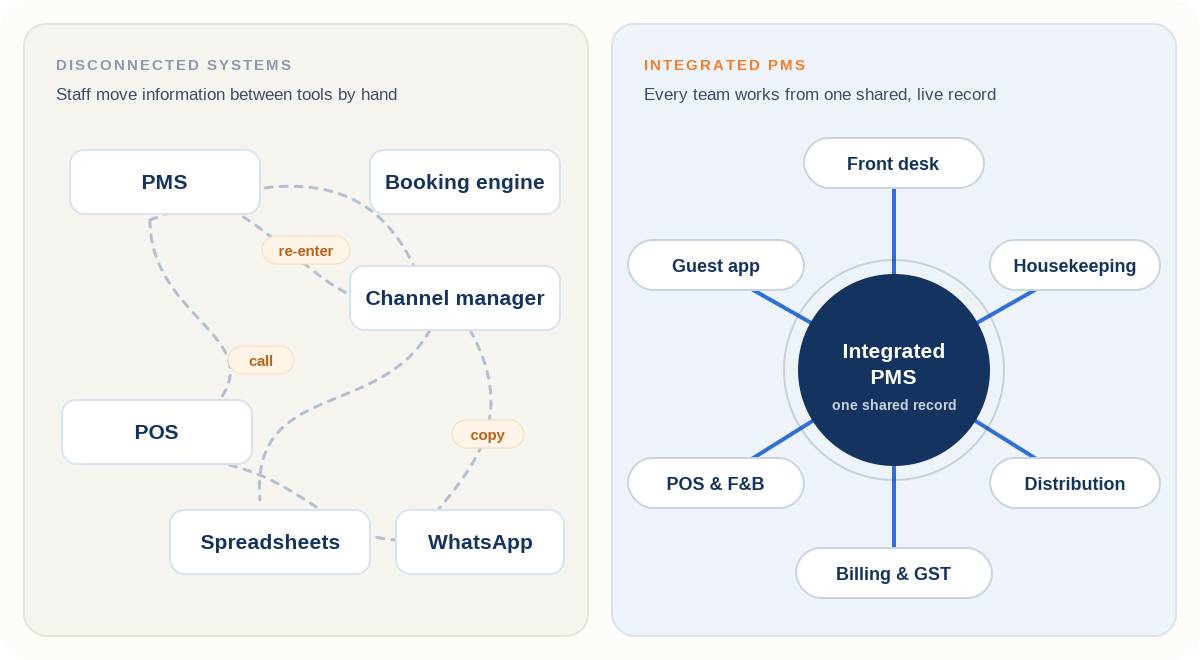
Disconnected workflows are hotel processes that depend on staff moving information between separate systems by hand. Teams re-enter data, make phone calls or pass notes to keep departments in step. Each tool may work well on its own, but the handoffs between tools create delays, duplicate entry and errors that someone must catch later.
- Room status lives in two places. Housekeeping updates a chat group, and the front desk waits for a call.
- POS charges travel by hand. The front desk re-keys restaurant bills into guest folios.
- Revenue types rates twice. The team updates a rate, then re-enters it in each OTA extranet.
- Guest requests scatter. A towel request moves from phone to paper slip to WhatsApp.
- Accounts reconcile billing by hand. The team matches invoices, GST and payments against folios every night.
Each step looks minor. Together, they become a chain of manual relays.
Why Hotels Have a Connectivity Problem, Not a Technology Problem
Many hotels run a separate PMS, channel manager, booking engine, POS, payment system, guest messaging tool and accounting software, with spreadsheets filling the gaps. Each point solution does one job well. The connectivity problem appears between them, where no single system owns the full picture and staff become the integration layer.
This tool sprawl builds up gradually: a channel manager for OTAs, a booking engine for direct bookings, a messaging app for guests. Each purchase makes sense on its own.
Yet every new tool creates new handoffs. Adding another tool rarely fixes a connectivity problem. It usually adds one more place where information falls out of step.
How Do Disconnected Systems Affect Hotel Teams?
Disconnected systems shift staff time from serving guests to moving information. Teams re-enter the same data, chase updates between departments, reconcile mismatched records at night audit and depend on the few colleagues who understand how the systems fit together. The result is slower work, more errors and heavier training.
- Duplicate data entry. An associate copies a corporate booking from email into the PMS, then retypes the GST details for billing.
- Information delays. Housekeeping finishes room 214 at 1:10 pm; the front desk hears twenty minutes later.
- Reconciliation and night audit. The night auditor matches POS reports and folios line by line to find one missing dinner charge.
- Re-keying errors. A ₹4,500 rate becomes ₹5,400 in one OTA extranet, and nobody notices until a guest asks.
- Key-person dependency. Only one manager knows how the spreadsheets connect, so month-end slips when that manager is away.
- Training overhead. New hires learn several systems and the workarounds between them.
How Do Disconnected Workflows Affect the Guest Experience?
Guests never see a hotel’s systems, but they feel every gap between them. Disconnected workflows show up as repeated questions, rooms not ready at check-in, missing or duplicate charges, forgotten requests and rates that differ across channels. Each failed handoff behind the scenes becomes a visible moment of friction for the guest.
- Guest details sit in separate systems, so guests repeat their details at every touchpoint.
- Housekeeping status reaches the desk late, so guests wait in the lobby for a room that is already clean.
- Staff post POS charges by hand, so guests dispute missing or duplicated bills at checkout.
- Requests travel on paper or chat, so the extra pillow never arrives.
- Revenue updates rates channel by channel, so guests see different prices on the website and an OTA.
- Folios need manual checks, so check-in and check-out take longer.
Guests rarely blame the software. They remember the hotel.
What Is an Integrated PMS?
An integrated PMS is a property management system in which reservations, front desk, housekeeping, channel distribution, billing, payments, POS and guest communication share one real-time record. When one team updates a booking, a room or a charge, every other team sees the change immediately, without re-entry or a nightly sync.
- Integrated: modules run on one shared system, or connect so deeply that they behave as one, with one guest record, one inventory and one folio.
- Interfaced: separate systems exchange data through connectors. Each interface adds a mapping to maintain and a point where data can lag.
Neither model is wrong, and good hotel PMS integrations still matter for tools such as accounting software or door locks. The real question is how many daily handoffs sit on the shared core.
How Does an Integrated PMS Connect Hotel Workflows?
An integrated PMS connects hotel workflows by carrying one guest record through every stage of the stay. Each department reads from and writes to that record, so booking details, room status, charges and payments move between teams automatically. Following a single guest journey shows where these connections replace manual handoffs.
- BookingReservations · Revenue
- Pre-arrivalFront desk · Housekeeping · F&B
- Check-inFront desk · Housekeeping
- StayF&B · Housekeeping · Front desk
- Check-outFront desk · Accounts
- Post-stayRevenue · Marketing · Management
Booking and Distribution
A guest books on MakeMyTrip. Through built-in channel distribution, the integrated PMS updates every connected OTA and the direct booking engine from one live calendar.
Pre-arrival
The reservation holds the guest’s arrival time and a request for a high floor. The front desk, housekeeping and the restaurant all see that profile.
Check-in
Housekeeping marks the room inspected on a phone, and the front desk sees the update instantly. Connected front desk and housekeeping workflows mean the guest walks into a ready room.
During the Stay
The guest orders dinner and asks for towels through the guest app. The POS posts the charge to the room folio, and housekeeping receives the towel request as a task.
Check-out and Billing
The folio already holds every charge. With GST-compliant billing and UPI payments, the system issues the invoice and reconciles the payment automatically. See GST Billing Rules for Hotels in India for invoice details.
Post-stay
The stay joins the guest’s history, ready for reporting and a more personal welcome next time.
Disconnected Systems vs an Integrated PMS: A Comparison
The difference between disconnected systems and an integrated PMS shows up in daily work. Disconnected systems rely on re-entry, phone calls and end-of-day reconciliation. An integrated PMS shares one live record, so updates, charges and reports stay consistent across departments. The table compares both models across eight operational areas.
| Area | Disconnected systems | Integrated PMS |
|---|---|---|
| Data entry | Same details typed into several systems | Entered once, shared everywhere |
| Room status | Passed by phone, paper or chat | Updated live for the front desk |
| Guest information | Scattered across tools and inboxes | One profile for every team |
| Billing | POS charges re-keyed into folios | Charges post to one folio automatically |
| Rate updates | Changed channel by channel | Changed once, sent to every channel |
| Reporting | Compiled from exports and spreadsheets | Drawn from the same live data |
| Staff training | Several systems plus workarounds | One system, learned by role |
| Guest experience | Waits, repeated questions, billing disputes | Ready rooms, accurate bills, faster checkout |
What Should Hotels Look for in an Integrated PMS?
Hotels should look for an integrated PMS that keeps one shared guest and reservation record, syncs front desk, housekeeping and billing in real time, and connects distribution, POS and payments without manual steps. It should also offer open APIs, reliable performance on weak internet, mobile access for staff and practical migration support.
- One shared guest and reservation record
- Real-time sync across front desk, housekeeping and billing
- Built-in or tightly connected channel distribution and direct booking engine
- POS charges that post directly to guest folios
- GST-compliant invoicing and UPI payments, for Indian hotels
- Open APIs and integrations with existing tools
- Multi-property management from one login
- Reliable operation on low or unstable internet
- Mobile access for staff
- Data migration support
- Easy training for new staff
How Can a Hotel Move from Disconnected Systems to an Integrated PMS?
A hotel can move to an integrated PMS by auditing its current tools, mapping where information is re-entered or delayed, and fixing the most painful handoffs first. A planned data migration, a phased rollout or parallel run, and role-based training reduce risk. The hotel should then measure the improvements its own teams observe.
- Audit current tools and workflows. List every system, spreadsheet and chat group.
- Map where information is re-entered or delayed. Trace one booking from reservation to invoice.
- Prioritise the most painful handoffs. Start where gaps cause guest complaints or night audit rework.
- Plan data migration. Choose which reservations, profiles, rates and open folios move, and validate them.
- Run a phased rollout or parallel run. Go live module by module, or run both systems briefly side by side.
- Train teams by role. Build training around each department’s daily tasks.
- Measure what changes. Compare your own indicators, such as room release time or billing corrections, before and after.
The Future: From Hotel Software to a Hotel Operating System
The next stage of hotel technology is not more tools. It is a connected operating layer where operations, distribution, revenue and guest experience share the same data, and where AI helps staff with routine work. In this model, AI supports hotel teams with suggestions and answers, while people keep the final decisions.
Shared data gives AI something useful to work with: a pricing recommendation can use live pickup instead of last week’s export. AI added on top of fragmented systems inherits their gaps, a pattern that the evolution of hotel channel management also shows.
PrimeGuest, a product of Cloud10 Hospitality, is one example of this AI-native, unified approach. The PrimeGuest PMS combines front desk, housekeeping, channel distribution, a direct booking engine, POS and a guest app, with AI revenue management recommendations and an AI Helper for staff. Hotel teams review and approve what the AI suggests.
Conclusion: Software That Works as One
Hotels have spent years adding software to solve individual problems. The next gain comes from connecting the tools and teams they already have. An integrated PMS reduces disconnected workflows by giving every department the same live record, so staff spend less time relaying information and more time looking after guests.
The hotels that run best won’t be the ones with the most software. They’ll be the ones whose software works as one.
Ready to connect your hotel’s workflows? See how PrimeGuest brings front desk, distribution, billing and guest experience into one AI-native platform.
You May Also Like
The system of record behind reservations, rooms, billing and guest information.
Read more →How rates and availability stay in sync across OTAs, and when you need a separate tool.
Read more →Why where AI sits in your hotel platform matters as much as what it can do.
Read more →Frequently Asked Questions
Simplify Hotel Operations with PrimeGuest PMS
PrimeGuest PMS brings reservations, guests, billing, operations and integrations onto one platform, so hotels run on live data instead of spreadsheets stitched together at month-end.
- AI-native PMS
- Cloud-based hotel management
- Hotel booking management
- GST billing
- Hotel PMS integrations
- Automated workflows
- Real-time visibility